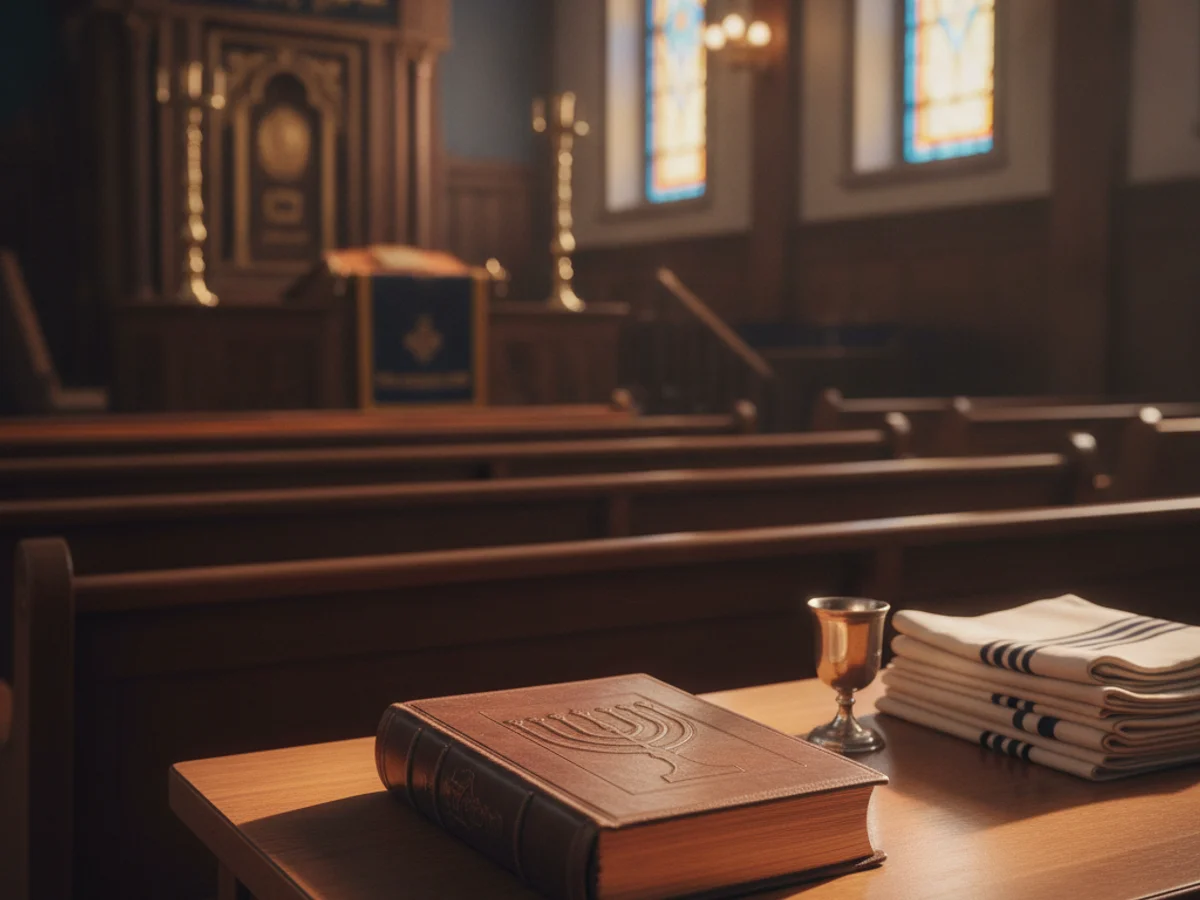
Walking into a synagogue for the first time as a conversion candidate can feel overwhelming — pages turn rapidly, Hebrew flies by, and everyone seems to know exactly where they are in the siddur. The good news: Jewish prayer services follow a consistent structure that becomes familiar with study and repetition. This guide breaks down every major service — Shacharit, Mincha, Maariv, Musaf, and the full Shabbat cycle — so you can follow along, understand what is happening, and participate with growing confidence.
📌 Key Takeaways
- There are 3 daily prayer services: Shacharit (morning), Mincha (afternoon), and Maariv (evening).
- Shabbat adds a 4th service (Musaf) and features a Torah reading that is central to congregational life.
- The siddur is organized by time of day and occasion — learning its logic is more important than memorizing every word.
- Each movement (Orthodox, Conservative, Reform, Reconstructionist) uses a different siddur but shares most of the same core prayers.
- Active participation in services is one of the most visible ways your Beit Din evaluates your integration into Jewish life.
Why Synagogue Services Matter for Your Conversion
Rabbis and Beit Din panels consistently name regular synagogue attendance as one of the top indicators of genuine commitment. It is not enough to study Jewish history or kashrut at home — you need to show that you are becoming part of a living Jewish community.
In practice, most rabbis expect conversion candidates to attend services regularly for at least 12 months before scheduling a Beit Din. For Orthodox conversions, consistent Shabbat attendance at a specific community is often mandatory. Conservative and Reform rabbis typically look for meaningful, ongoing participation rather than a fixed attendance count.
Understanding what happens during a service — and why — transforms attendance from a checkbox into a genuine spiritual practice. That shift is exactly what rabbis are looking for.
The Three Daily Services: An Overview
Judaism structures daily life around 3 prayer times, corresponding to the 3 daily offerings in the ancient Temple (korbanot). Each service has a distinct feel, length, and set of prayers.
Shacharit — Morning Prayer
Shacharit is the longest and most elaborate of the 3 daily services. On a typical weekday it lasts between 30 and 60 minutes depending on the movement and whether a Torah reading is included (Monday and Thursday mornings feature a short Torah portion in traditional congregations).
The major components of Shacharit are:
- Birkhot HaShachar — Morning blessings thanking God for waking, physical functions, and the gift of Torah
- Pesukei D'Zimra — "Verses of Song," a warm-up section of psalms and biblical poetry, culminating in Psalm 145 (Ashrei)
- Shacharit Amidah — The standing silent prayer, the devotional core of the service
- Tachanun — Penitential prayers (omitted on Shabbat, holidays, and certain joyful days)
- Torah Reading (Monday, Thursday, Shabbat, holidays)
- Aleinu — Closing prayer declaring God's sovereignty
Mincha — Afternoon Prayer
Mincha is the shortest service, often lasting only 10–20 minutes. It can be said any time from shortly after noon until nightfall. Many synagogues hold a combined Mincha-Maariv service just before and after sunset.
Mincha consists primarily of:
- Ashrei (Psalm 145)
- The Amidah (central standing prayer)
- Aleinu
On Shabbat afternoon, Mincha is longer and includes a Torah reading of the beginning of the following week's portion — a beautiful bridge between Shabbat weeks.
Maariv — Evening Prayer
Maariv (also called Arvit) marks the transition into a new Jewish day, since the Hebrew calendar day begins at nightfall. It includes the Shema and its surrounding blessings, the Amidah, and Aleinu.
On Saturday night, Maariv includes Havdalah-related passages marking the end of Shabbat. This is a moment of particular emotional resonance — the community collectively releases the sanctity of Shabbat and re-enters the ordinary week.
Shabbat Services: The Heart of Jewish Community Life
For conversion candidates, Shabbat services are the most important weekly commitment. They are longer, richer, and more communal than weekday services. Most synagogues expect you to attend Shabbat services consistently, not just occasionally.
Friday Night — Kabbalat Shabbat and Maariv
Kabbalat Shabbat ("Welcoming Shabbat") is a poetic service added in the 16th century by the mystics of Safed. It consists of 6 psalms representing the 6 days of the week, followed by the mystical poem Lecha Dodi — a song welcoming Shabbat as a bride. The congregation turns toward the entrance of the synagogue for the final verse, a tradition that still surprises first-time visitors.
Following Kabbalat Shabbat, the regular Friday night Maariv is recited, including a special version of the Amidah with a Shabbat theme.
In many synagogues, Friday night services are followed by an Oneg Shabbat — refreshments, singing, and community socializing. This is one of the best opportunities for a conversion candidate to form relationships within the congregation.
Shabbat Morning — Shacharit and Musaf
Shabbat morning Shacharit is significantly longer than the weekday version. A full Torah portion is read aloud from a handwritten scroll (Sefer Torah), divided into 7 aliyot (portions called up). A Haftarah reading from the Prophets follows.
The Torah service is one of the most visually and ritually rich parts of Jewish communal life:
- The Torah is carried through the congregation (Hakafah) before and after the reading
- Congregants touch the Torah with a siddur, tallit, or fingers and kiss it
- The Gabbai (Torah-reader coordinator) calls individuals up by their Hebrew name
After the Torah service, the Musaf ("additional") Amidah is recited, representing the additional Temple offering of Shabbat. Musaf adds another 20–30 minutes to the service.
In total, a traditional Shabbat morning service can last 2.5 to 3.5 hours. Reform and Reconstructionist services are often shorter, typically 1.5 to 2 hours.
Shabbat Afternoon and Evening
Mincha on Shabbat afternoon includes the Torah reading mentioned above plus study time in many congregations. Maariv at nightfall, combined with Havdalah — the candle, wine, and spice ceremony — formally closes Shabbat.
💡 Good to know
Arrive 10–15 minutes early to any service and ask the gabbai or a friendly congregant to point you to the right page. Most synagogue communities are genuinely happy to help conversion candidates find their footing — do not hesitate to ask.
Holiday Services: What to Expect
Major Jewish holidays bring their own distinctive services, often with special prayers, melodies, and Torah portions. Here is a quick-reference overview:
| Holiday | Key Prayer Addition | Approximate Service Length | Notable Feature |
|---|---|---|---|
| Rosh Hashanah | Musaf with Malkhuyot/Zikhronot/Shofarot | 3–5 hours (morning) | Shofar blowing (100 blasts) |
| Yom Kippur | Kol Nidre (eve), Ne'ilah (closing) | 5–6 hours (morning/afternoon) | Full-day fast, white garments |
| Sukkot | Hallel, Musaf | 2–3 hours | Lulav & etrog waved in 6 directions |
| Simchat Torah | Torah hakafot (7 circuits) | 2–3 hours | Joyful dancing with Torah scrolls |
| Passover | Hallel, Yizkor (8th day), Musaf | 2–3 hours | Song of Songs read on Shabbat Chol HaMoed |
| Shavuot | Akdamut poem, Book of Ruth | 2–3 hours | All-night Torah study (Tikkun Leil) |
| Purim | Megillah reading (eve & morning) | 1–2 hours | Costumes, noisemakers (groggers) |
Comparing Services Across Jewish Movements
One of the most practical questions for conversion candidates is: how do services differ between Orthodox, Conservative, Reform, and Reconstructionist congregations? The differences are significant and worth understanding before choosing a synagogue.
| Feature | Orthodox | Conservative | Reform | Reconstructionist |
|---|---|---|---|---|
| Language | Almost entirely Hebrew | Hebrew + some English | Mix; more English | Mix; egalitarian Hebrew |
| Mechitza (gender separation) | Required | No | No | No |
| Prayer leader (chazzan) | Male only | Male or female | Male or female | Male or female |
| Musical instruments on Shabbat | Never | Rarely | Often (organ/guitar) | Often |
| Torah aliyot (Shabbat morning) | 7 + Maftir | 7 + Maftir | Varies (often 3–4) | Varies |
| Weekday Musaf | Recited on holidays | Recited on holidays | Often omitted | Often omitted |
| Siddur used | ArtScroll / Koren | Sim Shalom / Lev Shalem | Mishkan T'filah | Kol Haneshamah |
For a deeper look at the denominational differences that affect your entire conversion journey, see our guide on Orthodox vs Conservative vs Reform conversions.
The Amidah: The Prayer at the Center of Everything
The Amidah (literally "the standing") is the devotional heart of every service. It is recited silently while standing, facing Jerusalem. On weekdays, it contains 19 blessings; on Shabbat and holidays, it is condensed to 7.
The 19 weekday blessings are organized into 3 sections:
- Praise (blessings 1–3): Invoking God's attributes — patriarchs/matriarchs, divine power, holiness
- Petition (blessings 4–16): Requests for knowledge, repentance, forgiveness, healing, prosperity, ingathering of exiles, justice, rebuilding Jerusalem, and more
- Thanks (blessings 17–19): Gratitude for Temple service, thanksgiving, and peace
After the silent Amidah, the prayer leader repeats it aloud (chazzan's repetition), and the congregation responds "Amen" to each blessing. On Shabbat and holidays, the repetition includes the Kedushah — a solemn, responsive declaration of God's holiness drawn from Isaiah 6:3.
⚠️ Warning
Do not talk during the chazzan's repetition of the Amidah or during the Torah reading. These are considered the most sacred moments of the service, and interrupting them is viewed as a serious breach of synagogue etiquette — even if unintentional.
Practical Synagogue Etiquette for Conversion Candidates
Knowing the prayers is only half the equation. Synagogue behavior carries its own set of expectations that conversion candidates should internalize early.
Dress code: Traditional congregations expect modest dress — covered shoulders and knees for women, a kippah for men (and increasingly for women in egalitarian congregations). Even in liberal synagogues, business-casual is the minimum for Shabbat.
Kippah and tallit: Men in traditional congregations wear a kippah at all times inside the synagogue. A tallit (prayer shawl) is typically worn by married men in Orthodox communities, and by all adults in many Conservative and Reform congregations. As a conversion candidate who is not yet Jewish, ask your rabbi whether and when to begin wearing a tallit.
Turning pages: The siddur generally moves right-to-left (Hebrew direction). If you are using an English-Hebrew interlinear, the congregation's page number is usually announced — pay attention. Many congregations now project page numbers on a screen.
Standing and sitting: The congregation stands and sits together at specific moments (Amidah, Kedushah, Torah procession). Watch the room and follow along until the pattern becomes second nature, usually within a few weeks.
Phones: Turn off your phone before entering. In traditional congregations, using a phone on Shabbat or holidays is strictly prohibited. In liberal congregations, it is still considered poor etiquette during services.
For more on deepening your prayer practice beyond the mechanics, see our comprehensive Jewish prayer basics guide for conversion students.
Building a Service Attendance Routine
Consistency matters far more than perfect comprehension. Even if you understand only 20% of the Hebrew, showing up every Shabbat morning for 12 consecutive months communicates something profound to your rabbi and community.
A practical routine for a conversion candidate might look like:
- Every Shabbat morning: Full service (most important)
- Occasional Friday night: Kabbalat Shabbat + Maariv, especially for community connection
- High Holidays: Both Rosh Hashanah and Yom Kippur services without exception
- At least 2–3 major holiday services per year: Sukkot, Passover seder + services, Shavuot
- Weekday services when possible: Even once a week shows serious engagement
Keep a simple log of the services you attend. Some rabbis ask for this record as part of the conversion documentation process. It also helps you track your own growth — a service that felt completely foreign at month 2 will feel familiar and meaningful by month 10.
Frequently Asked Questions
Do I need to understand Hebrew to attend services?
No — you do not need to understand Hebrew to begin attending services. Most synagogues provide siddurim with full English translation facing the Hebrew. Over time, your Hebrew literacy will grow organically through repetition. The goal in your first months is familiarity with the service structure, not fluency.
Can I receive an aliyah (Torah honor) before I convert?
In Orthodox and most Conservative congregations, no — aliyot are reserved for halachically Jewish individuals. In many Reform and Reconstructionist congregations, non-Jewish partners and family members are sometimes given aliyot, but this varies by community. Ask your rabbi specifically.
What is the Mourner's Kaddish, and should I recite it?
Kaddish is an Aramaic prayer praising God, recited by mourners and on yahrzeit (anniversary of death). It requires a minyan (quorum of 10 Jews). As a conversion candidate, you are not halachically Jewish and would not traditionally be counted in a minyan or recite Kaddish. However, some liberal rabbis allow it — ask yours.
How do I know which siddur to buy before I convert?
Match the siddur to the movement of the synagogue where you are studying. ArtScroll's Artscroll Siddur (with English) is standard for Orthodox communities; Sim Shalom or the new Lev Shalem for Conservative; Mishkan T'filah for Reform. Your rabbi will almost certainly recommend one in the first few weeks of conversion class.
Is it rude to leave in the middle of a service?
It depends on when. Leaving during the Torah reading or the chazzan's Amidah repetition is generally frowned upon. Leaving after the Torah service but before Musaf is common and accepted. Leaving during Aleinu (the closing prayer) is fine. When in doubt, wait for a natural break between major sections.
What is a minyan and does attendance count without one?
A minyan is a quorum of 10 adult Jews (all genders in egalitarian congregations; men only in Orthodox) required for certain communal prayers — including the Amidah repetition, Kaddish, and the Torah reading. If fewer than 10 are present, those portions of the service are omitted or modified. Your personal prayer is still valid and meaningful without a minyan — but communal prayer requires one.
How early should I arrive to a service?
For weekday services: 5 minutes early is fine, since they often start promptly. For Shabbat morning: aim for 10–15 minutes early, both to get oriented and to catch the beginning, which sets the tone. For High Holiday services: arrive 20–30 minutes early, as seats fill quickly and late arrivals can disrupt the atmosphere.
Conclusion
Jewish prayer services are not performances to observe from a distance — they are a living practice that becomes more meaningful with every week you show up. As a conversion candidate, each service you attend is both a learning experience and a statement of intent: you are not merely studying Judaism, you are beginning to live it.
Start with Shabbat morning, follow along even when you are lost, and let the rhythm of the siddur become part of your week. Within months, prayers that once seemed impenetrable will carry genuine emotional weight. That transformation — from bewildered visitor to engaged participant — is one of the most beautiful parts of the conversion journey.
Ready to deepen your practice? Explore the Join Judaism study platform for interactive Hebrew prayer tools, siddur guides, and Beit Din preparation resources designed specifically for conversion candidates.