The Jewish calendar is one of the most distinctive aspects of Jewish life. It structures time around sacred rhythms — weekly Shabbat, monthly new moons, and an annual cycle of holidays that move between joy and solemnity, feasting and fasting, memory and hope. For conversion candidates, understanding the holidays is essential: they will come up in your Beit Din interview, and more importantly, living through them is one of the most powerful ways to internalize what it means to be Jewish.
📌 Key Takeaways
- The Jewish calendar is lunisolar — holidays fall in the same season each year but shift on the Gregorian calendar
- The major holidays are Torah-mandated (d'oraita); Hanukkah and Purim are rabbinic (d'rabbanan)
- The three pilgrimage festivals — Sukkot, Passover, Shavuot — form the backbone of the agricultural/historical year
- Days begin at nightfall: every holiday starts the evening before its calendar date
- The High Holidays (Rosh Hashanah + Yom Kippur) are the most theologically significant period of the year
The Jewish Calendar
The Jewish calendar is lunisolar — it follows the lunar cycle for months but adds a leap month (Adar II) seven times every 19 years to stay aligned with the solar year. This is why Jewish holidays fall on different dates in the Gregorian calendar each year, but always in the same season.
Jewish days begin at nightfall, not midnight. This is why Shabbat begins Friday evening, and why every holiday starts the night before its calendar date. The pattern comes from Genesis: "And there was evening, and there was morning — one day."
| Holiday | Hebrew Date | Gregorian Season | Biblical/Rabbinic | Work Prohibited? |
|---|---|---|---|---|
| Rosh Hashanah | 1–2 Tishrei | Sept–Oct | Biblical | Yes |
| Yom Kippur | 10 Tishrei | Sept–Oct | Biblical | Yes |
| Sukkot | 15–21 Tishrei | Oct | Biblical | First/last days |
| Shemini Atzeret / Simchat Torah | 22–23 Tishrei | Oct | Biblical/Rabbinic | Yes |
| Hanukkah | 25 Kislev – 2/3 Tevet | Nov–Dec | Rabbinic | No |
| Purim | 14 Adar | Feb–Mar | Rabbinic | No |
| Passover | 15–21/22 Nisan | Mar–Apr | Biblical | First/last days |
| Shavuot | 6–7 Sivan | May–Jun | Biblical | Yes |
The High Holidays (Yamim Noraim)
Rosh Hashanah — The Jewish New Year
When: 1-2 Tishrei (usually September/October)
Rosh Hashanah ("Head of the Year") marks the beginning of the Jewish year and the start of the ten Days of Awe (Yamim Noraim). It is simultaneously a joyful new year celebration and a solemn day of divine judgment — tradition holds that God opens the Book of Life on Rosh Hashanah and inscribes the fate of every person for the coming year.
Key customs:
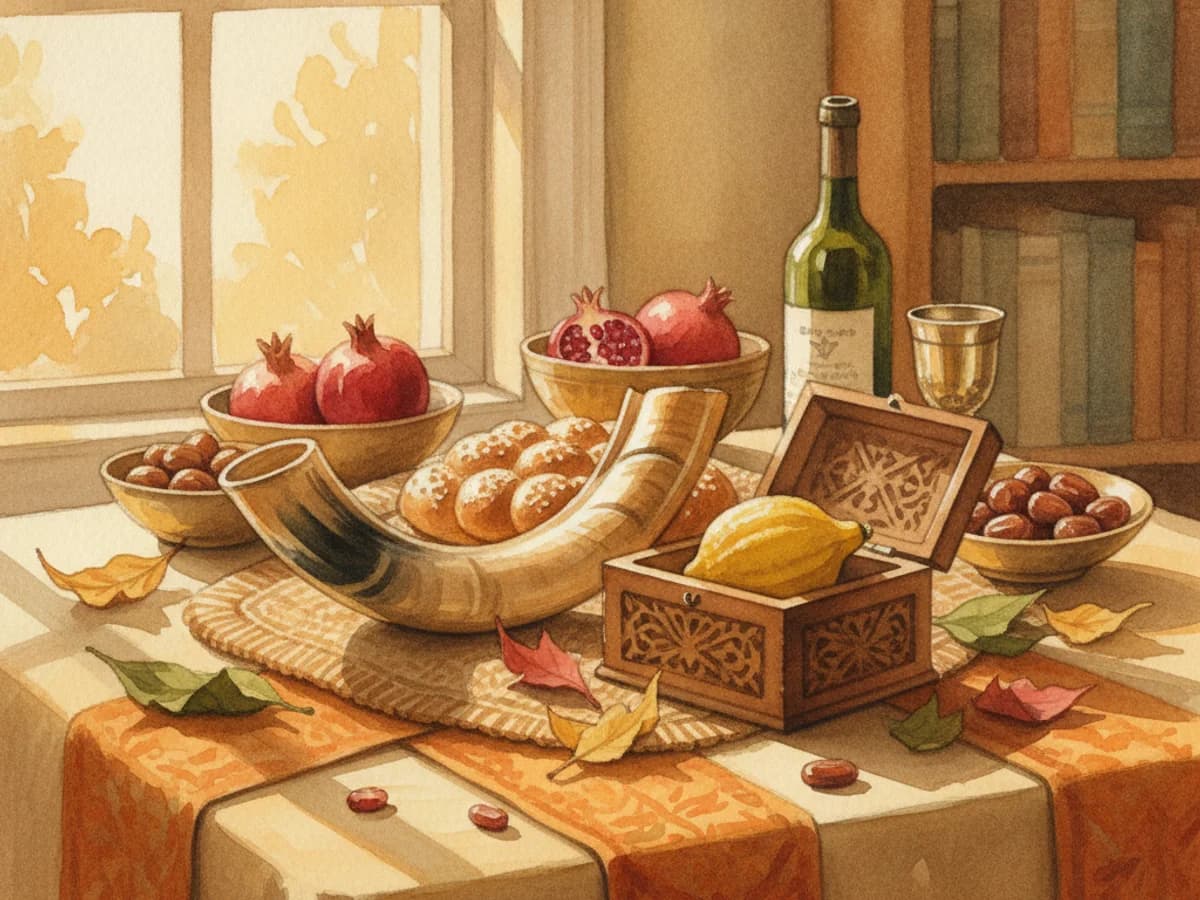
- Shofar (ram's horn) is blown up to 100 times during services
- Tashlich — casting breadcrumbs into flowing water, symbolizing the casting away of sins
- Eating apples and honey for a sweet new year
- Round challah (symbolizing the cycle of life)
- The traditional greeting: Shanah Tovah or L'Shanah Tovah Tikatevu ("May you be inscribed for a good year")
Yom Kippur — The Day of Atonement
When: 10 Tishrei (ten days after Rosh Hashanah)
Yom Kippur is the holiest day of the Jewish year — the day when the divine decree of Rosh Hashanah is sealed. It is a full 25-hour fast (no food or water) dedicated to prayer, repentance, and seeking forgiveness.
Jewish tradition teaches that Yom Kippur atones for sins against God — but not for sins against other people. Before Yom Kippur, Jews are expected to seek forgiveness directly from anyone they have wronged during the year.
Key customs:
- 25-hour fast beginning before sunset
- Five prohibited activities: eating/drinking, bathing for pleasure, wearing leather shoes, anointing with oils, marital relations
- Kol Nidre — the haunting chant that opens the Yom Kippur evening service, annulling unfulfilled personal vows
- Vidui (confession) — recited in the plural throughout the day
- Ne'ilah — the closing prayer service, as the gates of heaven close
- The shofar is blown once at the end of Ne'ilah
💡 Good to know
The High Holiday theology rests on three pillars: *Teshuvah* (repentance), *Tefillah* (prayer), and *Tzedakah* (charity). The liturgy teaches these three practices "avert the evil decree."
Preparing for the High Holidays
For many conversion candidates, experiencing the High Holidays for the first time can be overwhelming. One important difference to notice is the communal language of confession: much of the liturgy speaks in terms of what “we” have done, placing individual reflection within collective responsibility.
The preparation period, known as Elul (the month before Rosh Hashanah), involves daily shofar blowing, recitation of Psalm 27, and intensive self-reflection. Many congregations offer special classes during this time, making it an ideal entry point for prospective converts to begin engaging with the community.
💡 Good to know
During the Ten Days of Repentance between Rosh Hashanah and Yom Kippur, some traditional Jews avoid meat except on Shabbat as an additional spiritual discipline. This period is considered especially auspicious for prayers and charitable giving.
Sukkot — The Feast of Tabernacles
When: 15-21 Tishrei (five days after Yom Kippur)
Sukkot ("Tabernacles" or "Booths") is one of the three pilgrimage festivals (shalosh regalim). It commemorates the 40 years the Israelites lived in temporary shelters in the desert after the Exodus, and celebrates the autumn harvest.
Key customs:
- Building and dwelling in a sukkah — a temporary outdoor hut with a roof of natural plant material (schach), through which you should be able to see the stars
- Waving the four species (arba minim): etrog (citron), lulav (palm frond), hadassim (myrtle), and aravot (willow)
- Hoshana Rabbah (the 7th day) — considered the final sealing of the divine decree
- Shemini Atzeret and Simchat Torah follow immediately after
Building a Sukkah: Modern Practices
The sukkah must have at least three walls and be tall enough to stand in, but the variations are extensive. Candidates who cannot build one at home can ask a synagogue, campus group or local family whether they may help build and decorate a communal sukkah. Participating in the work can make the holiday's practical rules easier to understand.
The halachic requirements for a kosher sukkah are precise: walls must be at least 10 tefachim (approximately 40 inches) high, and the schach must provide more shade than sunlight while still allowing rain to enter. Many modern families use bamboo mats, wooden slats, or branches, often decorated with fruits, artwork, and lights.
Simchat Torah
When: 22-23 Tishrei (immediately after Sukkot)
Simchat Torah ("Rejoicing in the Torah") celebrates the completion of the annual Torah reading cycle and its immediate restart. Torah scrolls are taken from the ark and carried in joyful processions (hakafot) around the synagogue, often accompanied by singing and dancing. It is one of the most joyful moments in the Jewish year.
Hanukkah — The Festival of Lights
When: 25 Kislev – 2/3 Tevet (usually November/December)
Hanukkah commemorates the Maccabees' victory over the Seleucid Greeks who had desecrated the Temple (165 BCE), and the miracle of a small flask of oil that burned for eight days — long enough for new oil to be prepared.
Despite its commercial prominence in the United States (due to its proximity to Christmas), Hanukkah is a minor holiday in the Jewish calendar in terms of halachic weight. It has no work prohibitions and is not biblically mandated.
⚠️ Warning
A common Beit Din mistake: candidates say Hanukkah is one of the most important Jewish holidays because of its cultural visibility. In halachic terms, it is *minor*. The High Holidays, Shabbat, and Passover are far more significant in Jewish law.
Key customs:
- Lighting the hanukkiah (nine-branched menorah) for eight nights, adding one candle each night
- Placing the hanukkiah where it can be seen to publicize the miracle (pirsumei nisa)
- Eating foods fried in oil: latkes (potato pancakes) and sufganiyot (jelly doughnuts)
- Dreidel (spinning top) with the letters Nun, Gimel, Hey, Shin — "A great miracle happened there" (in Israel: Peh for "here")
The Historical Context of Hanukkah
The Hanukkah story represents one of the earliest recorded struggles for religious freedom. The Seleucid ruler Antiochus IV Epiphanes not only banned Jewish practices but forced Jews to worship Greek gods and sacrifice pigs in the Temple. The Maccabean revolt, led by Mattathias and his sons (especially Judah Maccabee), was both a war of independence and a civil war between Hellenized Jews and traditionalists.
Maria, a history professor from Miami who converted five years ago, notes: "Understanding Hanukkah helped me grasp the tension that runs through Jewish history — the balance between engaging with the surrounding culture and maintaining distinct Jewish identity. It's a conversation that continues today."
Purim — The Festival of Masks
When: 14 Adar (usually February/March)
Purim celebrates the rescue of the Jewish people of ancient Persia from Haman's decree to destroy them, as told in the Megillat Esther (Book of Esther). It is one of the most joyful days in the Jewish calendar.
Key customs:
- Reading the Megillah (Scroll of Esther) twice — on the night and morning of Purim
- Drowning out Haman's name with noise (greggers/ra'ashanim) every time it is mentioned
- Mishloach manot — sending food gifts to friends
- Matanot la'evyonim — giving charity to the poor
- Mishteh — a festive Purim feast
- Dressing in costumes (reflecting the hidden nature of God and Esther's hidden identity)
- Hamantaschen — triangular pastries filled with jam or poppy seeds
Passover (Pesach) — The Festival of Freedom
When: 15-21/22 Nisan (usually March/April)
Passover is the most widely observed Jewish holiday, commemorating the Exodus of the Israelites from slavery in Egypt. Its central commandment is retelling the story of the Exodus to the next generation — "And you shall tell your children on that day" (Exodus 13:8).
Key customs:
- Removing all chametz (leavened grain products) from the home before Pesach
- Bedikat chametz — searching for chametz by candlelight the night before Pesach
- Eating matzah (unleavened bread) throughout the holiday
- The Passover Seder on the first night(s) — a ritual meal using the Haggadah (the telling)
- The Seder plate: maror (bitter herbs), charoset, karpas, zeroa (shankbone), beitzah (egg), chazeret
- Four cups of wine, representing four expressions of redemption
- The afikoman — a hidden piece of matzah ransomed from children at the end of the meal
The Haggadah instructs: "In every generation, each person is obligated to see themselves as if they personally left Egypt." Passover is not just a history lesson — it is an act of identification with the ongoing Jewish story of liberation.
The Passover Kitchen: A Transformation
For many conversion candidates, the extent of Passover preparation comes as a surprise. The kitchen undergoes a complete transformation: all chametz is removed or sold, dishes and cookware are changed or kashered, and special Passover foods replace everyday staples.
Passover preparation can be substantially more involved than ordinary kashrut practice. If your sponsoring community observes detailed kitchen preparation, ask a host family or rabbi to demonstrate its approach rather than assuming every household follows the same procedures.
The search for chametz (bedikat chametz) traditionally takes place the night before Passover, using a candle, wooden spoon, and feather to collect any remaining crumbs. Some families hide pieces of bread around the house for children to find, making the ritual both educational and engaging.
For deeper understanding of dietary laws during the holiday, consult our guide on kashrut for conversion.
Shavuot — The Feast of Weeks
When: 6-7 Sivan (fifty days after Passover, usually May/June)
Shavuot ("Weeks") marks the giving of the Torah at Mount Sinai, exactly 50 days after the Exodus. It is the most intellectually oriented of the pilgrimage festivals.
Key customs:
- Staying up all night studying Torah (Tikkun Leil Shavuot)
- Reading the Book of Ruth (Ruth's conversion is a model for Jewish converts)
- Eating dairy foods (cheesecake, blintzes) — various reasons are given
- Synagogue decoration with flowers and greenery
- Confirmation ceremonies in Reform and Conservative synagogues
The Sinai revelation is understood as the moment when Israel collectively "converted" — accepting the Torah and the covenant with God. For this reason, Shavuot has a particular resonance for conversion candidates.
The Book of Ruth and Conversion
The reading of Ruth on Shavuot holds special significance for conversion candidates. Ruth's declaration to Naomi — "Your people shall be my people, and your God my God" — is considered the paradigmatic statement of conversion. The story demonstrates that Jewish identity can be chosen rather than inherited, and that converts can become integral to the Jewish story (Ruth becomes the great-grandmother of King David).
During Tikkun Leil Shavuot, many study halls include sessions specifically focused on conversion themes, examining Ruth alongside other biblical and rabbinic texts about joining the Jewish people.
The Fast Days
Beyond Yom Kippur, several minor fast days mark moments of national tragedy:
| Fast Day | Hebrew Date | What It Commemorates | Duration |
|---|---|---|---|
| Tisha B'Av | 9 Av | Destruction of both Temples; other tragedies | 25 hours |
| 17 of Tammuz | 17 Tammuz | Breach of Jerusalem's walls | Dawn to nightfall |
| Fast of Gedaliah | 3 Tishrei | Assassination of Gedaliah ben Ahikam | Dawn to nightfall |
| 10 of Tevet | 10 Tevet | Beginning of Nebuchadnezzar's siege | Dawn to nightfall |
| Fast of Esther | 13 Adar | Esther's fast before approaching the king | Dawn to nightfall |
Understanding the Three Weeks
The period from the 17th of Tammuz to Tisha B'Av is known as "The Three Weeks" — a time of increasing mourning that culminates in the most solemn fast day of the Jewish calendar. Orthodox Jews refrain from haircuts, weddings, and listening to music during this period. The final nine days (1-9 Av) include additional restrictions on eating meat and drinking wine (except on Shabbat).
This period teaches an important lesson about Jewish collective memory — even joyous communities carry the weight of historical trauma, and the calendar ensures these memories are not forgotten.
Regional and Cultural Variations
Sephardic vs. Ashkenazi Customs
Holiday observances vary significantly between Jewish communities. For example, Sephardic Jews eat rice and legumes (kitniyot) during Passover, while Ashkenazi Jews traditionally do not. Sephardic Rosh Hashanah seders include symbolic foods like dates, pomegranates, and fish heads, while Ashkenazi traditions focus on apples and honey.
Understanding these differences becomes particularly important if you are converting within a specific Jewish movement. Learn more about how different Jewish traditions approach conversion to contextualize these holiday variations.
Modern Adaptations
Contemporary Jewish communities have developed new traditions that honor ancient themes while addressing modern realities. Urban sukkahs appear on apartment balconies and synagogue courtyards. Virtual Seders connected families during the COVID-19 pandemic. Environmental consciousness has influenced Sukkot decorations and Tu BiShvat celebrations.
Lisa, an environmental scientist from Seattle who converted six years ago, observes: "I was surprised how adaptable Jewish tradition is. My congregation's sukkah uses solar lighting, and we discuss climate change during the harvest blessing. Ancient wisdom, contemporary application."
💡 Good to know
Many conversion candidates find it helpful to create a "holiday journal" during their study period, attending services and celebrations for each holiday and recording their observations and questions. This personal record becomes invaluable preparation for the Beit Din interview.
Preparing for Your Beit Din
The holidays represent a significant portion of the Beit Din interview. You should be able to name and explain each major holiday, describe key customs, and understand the High Holiday theology. Expect questions about the theological significance of different holidays, their biblical vs. rabbinic origins, and how they connect to broader themes of Jewish identity and memory.
Be prepared to discuss which holidays you've personally experienced and what you learned from them. Beit Din panels often ask about the "journey" holidays (Passover to Shavuot via the Omer counting) and the theological framework of the High Holidays. Understanding the calendar structure — why holidays move on the Gregorian calendar but maintain seasonal consistency — demonstrates sophisticated Jewish knowledge.
For comprehensive preparation strategies, explore our guide to Beit Din preparation, which includes dedicated sections on every major holiday.
Frequently Asked Questions
At what point in the year should conversion candidates know all the holidays?
You don't need to memorize the exact Gregorian date of every holiday, but you should understand their Hebrew names, the season they occur in, and how they fit into the lunisolar Jewish calendar structure. Most conversion candidates go through at least one full holiday cycle before their Beit Din, which naturally reinforces this knowledge.
How can I observe holidays before my final conversion?
Rabbis generally encourage conversion candidates to participate in holiday celebrations as part of their learning process. Attend synagogue services, accept invitations to holiday meals, and volunteer to help with community celebrations. This experiential learning complements your formal study.
What's most important to understand about the High Holidays?
The High Holidays (Rosh Hashanah and Yom Kippur) embody the three pillars of Judaism: Teshuvah (repentance), Tefillah (prayer), and Tzedakah (charity). Understand that Rosh Hashanah is the day of judgment (when God "writes" each person's fate) and Yom Kippur is the day of sealing (when the judgment becomes final). Beit Din candidates should be able to explain this distinction.
Why do some holidays last two days in diaspora and one day in Israel?
This custom dates back to pre-fixed calendar times, when there was uncertainty about the exact date of the new moon. For safety, diaspora communities observed an extra day (Yom Tov Sheni shel Galuyot). Israel and Reform communities generally observe one day; Orthodox and Conservative diaspora communities observe two days.
Can I observe holidays differently depending on my conversion movement (Orthodox, Conservative, Reform)?
Yes, absolutely. Customs and levels of observance vary significantly between movements. For example, most Reform synagogues don't distinguish between biblical and rabbinic holidays in terms of work restrictions. Ask your sponsoring rabbi early on what observances are expected in your specific context.
How can I find a welcoming community to experience the holidays?
Look for a synagogue congregation that feels inviting and offers classes or orientations for conversion candidates. Most synagogues provide access to community holiday celebrations. Your sponsoring rabbi or sponsor can introduce you to families who might welcome you for holiday meals and help you navigate the customs.
How long does it take to master holiday practice before Beit Din?
There's no set period, but candidates who have lived through one full cycle (ideally two cycles) of holidays before their Beit Din demonstrate richer understanding. You should be able to articulate your personal experiences with each major holiday and what you learned spiritually from participating.
Observance customs vary by Jewish movement and community. This guide presents mainstream traditional practices while noting significant variations where they exist.